Liturgical Intelligence: Breath III
Called by Name
Alex Nutting, 18 August 2026


The mornings were not disciplined. I had planned for discipline.
I had curriculum binders, a schedule, and reasonable expectations about phonics and handwriting. I had read enough Charlotte Mason to have opinions about nature study. I had not read nearly enough about actual children to understand what I was signing up for.
What I had not planned for was the dry ice.
A food delivery arrived packed with it, and before I had finished signing for it one of the boys had found it, and the lesson plan for that morning had been replaced by an impromptu investigation of sublimation on the back patio: dry ice bubbling and smoking in a mixing bowl while I tried to explain phase changes to a six-year-old who was mainly interested in whether we could use a bigger bowl. We could. We did. The pool was the obvious next choice. The morning had intended to be language arts, but it became science. The expensive curriculum binder waited inside, unbothered.
This was, I was slowly learning, the actual nature of the work.
The paint splattered on the floor before I reached the table where I had set it up for my oldest child with a canvas. The youngest one had seen the paint, and the delight was sufficient reason to apply it to the nearest available flat surface, which was the floor, and then the wall at approximately toddler height. Next came her own arm, of course, with great satisfaction and no apology. Shouts of “I can do it myself” arrived from the kitchen where someone had decided that pouring their own milk was a right and not a privilege, and the subsequent puddle confirmed they were correct about the right and incorrect about the execution.
I had been waking up with a list of what I needed to accomplish, and going to bed having accomplished almost none of it- having done a hundred things that were not on the list. For a while I experienced this as failure, because the list was the measure I had brought with me, but the days kept refusing to be measured by it.
What I was slower to understand was that the days were offering a different kind of lesson entirely.
The dining room table by then had become several things at once. On some mornings it held curriculum binders, pencils, and the specific geometry of a four-child school day. On others it was covered so thoroughly in crayons and construction paper that you had to clear a space at one end just to set a plate down. During Advent and at Lent we lit a candle there at dinner, a small one, a way of marking the season and holding back the noise. I cannot tell you exactly when I understood that we were doing something liturgical at that table. I only knew that on the evenings when we lit it, something in the room slowed. Something was being kept.
My children were named before they had language for what they were doing to me. Each one arrived and the world grew heavier. I was looking at the same trees, the same roads, the same neighborhood we had moved into, but now as someone who would have to account for what he did with them. Stewardship is not abstract when it has a face that is watching you for cues about how the world works.
We were walking the neighborhood one afternoon when my son correctly identified a cardinal by sound. Not pointed at it. Named it. “Oh, a cardinal!” The ordinary miracle of a child learning to name the world, which is the first and oldest thing we are asked to do, and which no program could have produced more efficiently than this: a child, a birdsong, a walk, and the right conditions of attention.
One day my youngest demanded I stop the van for a butterfly. I did not stop. She made her feelings about this known in terms that left no ambiguity whatsoever, and later I understood that she had been right. The butterfly mattered. The schedule did not.
She handed me a flower one afternoon, sideways, as we were walking. Not a gift exactly. A keeping. She wanted to save it for later and I was, apparently, the person she trusted to carry it. I put it in my cargo pocket. She had been handing me things to carry since before she had words for asking.
Rocks made their way home in their pockets without announcement. Pinecones appeared on windowsills. Shells arrived on the dresser. We were reading about geodes and volcanoes with the older boys, and the neighborhood had apparently become a laboratory without asking my permission.
I found two books that season that I kept thinking about. One was The Blue Book of Favorite Songs, published in 1928, with a name written in pencil on the inside cover and a typewritten index card tucked between the pages that said: SUGAR COOKIES. Nothing else. The American Creed was in there too, between the songs and responsive readings. The other book was a 30 day meditation about the Nicene Creed. I had gone looking for one and found the other by accident, and I kept returning to the contrast between them.
The American Creed is a creed of self-construction. Of becoming, achieving, building, declaring. The Nicene Creed is a creed of reception. Inherited faith, carried community, believed in chorus. What struck me, sitting with both of them at that same table where we lit the candle in the evenings, was an idea I encountered somewhere in those readings: that in earlier centuries, the faithful were not expected to know the creed completely.
Only to carry it faithfully.
Not to know. To carry.
I had been at the church long enough by then to have opinions about what it needed, and energy enough to begin doing some of it before anyone had asked. The newcomers brochure seemed necessary. The welcoming committee had stalled, Easter was approaching, and I had the skills and the time to produce something that would be ready for visitors. So I did.
They were upset. The process mattered more than the outcome in their understanding. The relationship mattered more than the product. I had stepped into a lane that was not mine and produced something without going through the channels that existed precisely to prevent someone from doing exactly what I had done. They were not wrong about the channels. I was not wrong about the gap. But I had not yet planted deeply enough into the slow soil of that community to understand what it was actually asking of me, and what I experienced as efficiency they experienced as disregard.
The voice in my head told me that I should just stay in my lane, that I should stop being so difficult to manage. But the softness of the monk had given way to the armored defenses of a knight, and he wasn’t ready to relent yet.
I did not have a ‘lane’ in the traditional sense. The nearest available bucket was something like enthusiastic new volunteer, limited scope, ‘manage carefully’. It did not account for someone who could think strategically, lead and plan; and also pray and write and sing, who had arrived carrying a formation that did not fit the available categories. Not a pastor. Not a professional communicator in the business school sense. Not a bored stay-at-home dad, though I understood why that was the nearest approximation.
I was someone who had been named in pieces by different communities at different times, and who was now standing in a room where no one had a name that fit, and who was beginning to understand that this was its own particular kind of ache.
When I left the church role, I did not return to the monastery.
To be a monk had required credentials I did not have, institutional belonging I had not been granted, and a severity of schedule that my children had long since demonstrated was incompatible with the actual texture of our days. What the suburban monastery had also required was the kind of solitude that generates community rather than substituting for it, and that was not something I could produce alone in the parish hall while another committee was upset about the brochure.
It was a castle now.
The monastery withdraws. The castle defends. And what I needed to defend, in the accelerating noise of a fractured society in the early years of the AI age, was the things I had been slowly learning to see. The cardinal. The butterfly. The flower carried in my pocket. The Nicene Creed, held faithfully by someone in his nineties who could barely stand.
The world outside the walls was getting louder and faster and more certain of itself. Inside, my youngest was handing me pinecones, maple ‘helicopter’ seeds, and telling me their names.
Maybe what we lost was not the dream. Maybe it was the table.
I had been so busy looking for somewhere to be received that I had almost missed where I already was.
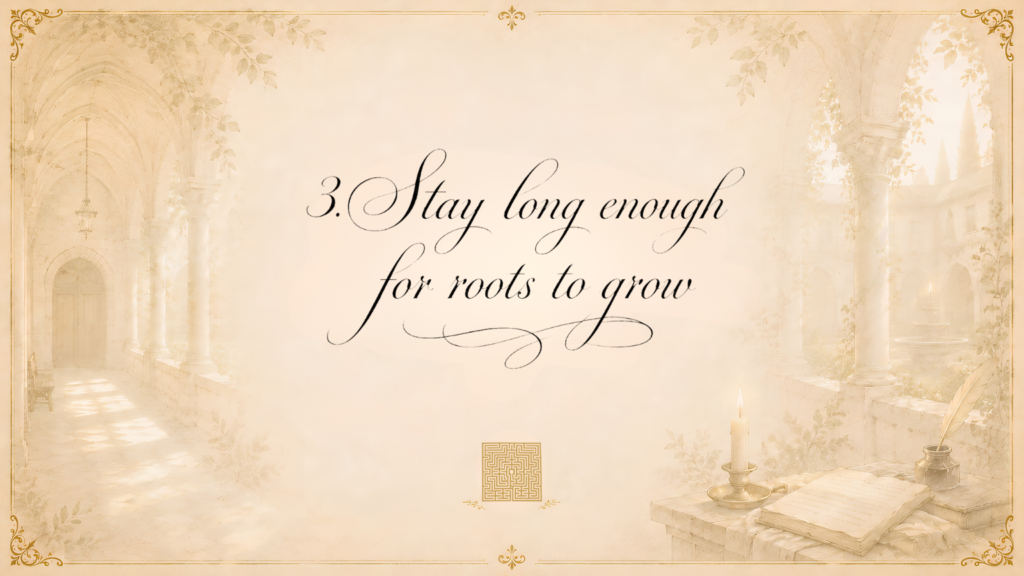
The third turn through my labyrinth revealed the third rule:
The Strategic Disciple is a reader-supported publication. To receive new posts and support my work, consider becoming a free or paid subscriber.
This piece is part of the Breaths series. It works best read in order, beginning with Breath I: A Good Light.
Explore the larger project:
TheStrategicDisciple.com — Quiet enough to be felt
LiturgicLabs.studio — Faithful imperfections for the faithfully imperfect
Ko-Fi — The tip jar to keep the coffee press going
© 2026 The Strategic Disciple, LLC. All rights reserved.