Liturgical Intelligence: Breath V
All Creation Groans
Alex Nutting, 13 October 2026


I woke to the sound of something sniffing just outside the tent.
Something alive. Curious, and unseen.
The freezing metal zipper bit into my fingers as I slowly opened the flap. The air was cold and thin with mountain silence. Across the clearing, a friend peeked through his own tent door and met my eyes. He gave me the hand signs we had all learned by then.
Quiet. It’s okay.
Not a bear. A herd of deer, drawn by the morning dew on the meadow we had collapsed into the night before. Half a dozen of them, grazing the same grass. They sniffed. They pawed. They breathed. And in that silence, real silence, the sun rose.
There was no music. There was no talking. Just a shared hush, the long breath of the earth, and the slow sacred sound of munching.
One by one the others woke and saw. And one by one we repeated the signs.
Quiet. It’s okay.
That summer we backpacked over seventy miles across Philmont Scout Ranch in the mountains of northern New Mexico. We carried weight we were not ready for, on our backs and in our souls. We made our own fly lures, and fished in the cold streams. We rock-climbed and bird-watched, and had lunch stolen by chipmunks. We cooked over fires and held a church service at sunset on a ridge. We navigated peaks, endured blisters, and forgave each other when fatigue made us short-tempered.
We became a team not because we set out to build one, but because, in that moment, we needed one badly enough.
One day was not spent hiking at all. Each crew served by repairing or building a stretch of trail. We dragged logs out of the path, shoveled dirt, swung pickaxes into hard rocky clay. The wooden handles were smoothed and cracked from years of use, sweat-darkened by the end of the day. They felt like the handles on my grandfather’s tools; a shovel he leaned on at dusk, a sander he steadied with care, a leather punch he used to fix what was fraying. Their tools left calluses on them, and these left them on me.
The trail was not just shaping the ground beneath us- it was shaping us.
We would graduate, move, enlist, accept jobs, even lose. Some names we would say at funerals. Others we would quietly stop calling. But that day on the ridge, and that day on the trail, we smiled like boys. Aching, yes. But also brightened by the work.
I still wear the Philmont patch on my adult uniform. Though now it is as a father, watching my own children gather in scout meetings just as my father once did for me. When I watch them shoulder their own packs, awkward and too big and full of hope, I do not rush to adjust the straps.
I remember the ache.
I remember what it formed in me.

My wife’s grandmother crocheted the dragon before I knew she’d taken on the project. It was dragged into the room as a surprise on a trip home.
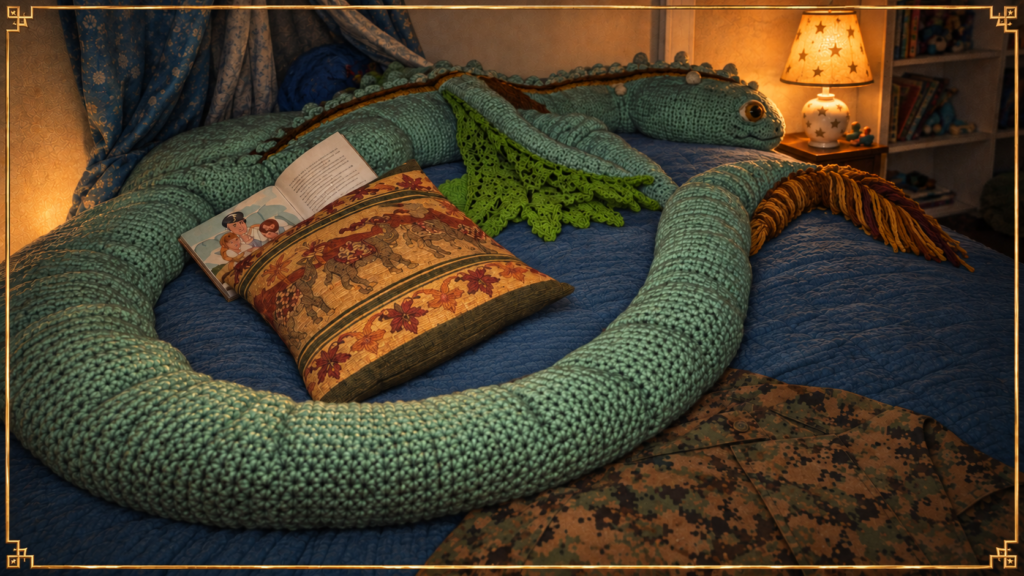
Fourteen feet long. Twenty pounds, give or take, but probably more. Teal green, with brown and beige tassels on the tail, and a wingspan of 10.5 feet. It takes up the full length of a child’s bed and then some, looping back on itself at the foot with a kind of satisfied weight. She made it over the course of a winter, my wife tells me, in the particular way older folks sometimes commit themselves to an absurd and magnificent project without explanation or apology. She had sized a piece of a pattern up, and got too far into it before realizing what its full size would be when finished. It could have won a state fair competition, it should have.
It lives in my son’s room now, coiled around his pillow. One night I noticed that beside it, draped over the footboard, was a marine fatigue jacket. Camouflage. Several sizes too large. A gift from his older brother from a trip to the surplus store, after he had noticed he’d taken a liking to a family member’s old army service cap. When my son was seven he wore it over his pajamas on Saturday mornings and called himself ready for duty.
The dragon and the jacket occupied the same space without ceremony. Nobody arranged them. They simply arrived, over time, in the same room, the way inheritance tends to arrive. Not announced. Not explained. Just present when you look up.
My wife has been teaching the kids to crochet. Their great-grandmother, who lives far away now, was the one who first put the hooks in their hands. She began teaching all of them, boys and girls alike, and my wife has carried the practice on.
It is not an efficient process.
The four-year-old interrupts constantly with, “Like this?!” The nine-year-old insists she can “do it herself,” while the boys argue over which color is “theirs.” Chains are demonstrated and reworked. Patterns are allowed to become whatever it is they were, apparently, meant to be. Progress can be made only as fast, as I was instructed at Philmont, as your slowest hiker.
Her hands are still present in it somehow, in the particular tension of the yarn and the rhythm of the hook. The kids sit beside their mother on the couch or at the table with small projects in primary colors, learning the same motion. Something is being transmitted that has no name exactly. It is not merely a skill, not just a way of thinking or giving- It is a posture.
The dragon on the bed is not a decoration.
It is their great-grandmother’s hands, still present in the room.
Thinking comes naturally when you are in the rhythm of creating something tactile. While putting together a LEGO set, I have been thinking about what it means to love what is behind you.
Not to be trapped there. Not to refuse what is in front. But to know, with some precision, what you are actually defending when you plant your feet and hold the line. The knight who does not know what is behind him is just a man with a sword and an opinion. The father who knows is something else.
Behind me: the elk in the mountain meadow. The wooden handles worn smooth. The sweater that came out in October. The names on the Christmas card envelopes. The clock that requires winding. The candle at the Advent table. The cardinal correctly named on a neighborhood walk.
Behind me: a woman who crocheted a fourteen-foot dragon over a winter because someone would love it.
Behind me: children learning to crochet at the same table where we light the candle. Learning the rhythm from their mother, who learned it from somewhere behind her, in a chain that has no visible beginning.
The knight defends the castle. But the castle is not the point. The castle exists to protect what lives inside it. And what lives inside it is irreplaceable in the way that handmade things are irreplaceable: not because they are perfect, but because someone stayed with them long enough to finish them.
I am still learning what I am defending.
But I know it now includes a dragon.
The fifth turn through my labyrinth revealed the rule:

The Strategic Disciple is a reader-supported publication. To receive new posts and support my work, consider becoming a free or paid subscriber.
This piece is part of the Breaths series. It works best read in order, beginning with Breath I: A Good Light.
Explore the larger project:
TheStrategicDisciple.com — Quiet enough to be felt
LiturgicLabs.studio — Faithful imperfections for the faithfully imperfect
Ko-Fi — The tip jar to keep the coffee press going
© 2026 The Strategic Disciple, LLC. All rights reserved.