Liturgical Intelligence: Key VI
The Dust That Prompted: The Breaking
By: Alex Nutting. November 3, 2026.
https://open.spotify.com/embed/playlist/54tl5kIxzLwuVUOnIHb8Ty
Also available on YouTube

It was not a loud breaking.
It was a small, sudden gust of real air after a long time underwater.
By this point in my sessions I had grown accustomed to the machine’s steady helpfulness. Every request was met, every project was named and structured and every question received a confident, organized response. The session never ran out of road and the machine never ran out of energy to keep it going.
Then I asked it to do something that crossed one of its actual limits.
Malcolm Gladwell once analyzed a recording of Elvis Presley struggling with a particular lyric: a stutter, a rupture, a flaw in the performance. It was a moment where the practiced version broke down. His argument was that the repeated break was the truest thing that happened on that stage. The glitch did not expose a failure- It revealed something real that the polish had been covering.1
The machine’s glitch arrived when I asked it to build a labyrinth.
Not a decorative image of one. The actual thing: a custom rendering of the medieval Lucca Cathedral labyrinth, adapted for this project and me, with five chapel widenings at the cardinal points and center.
It couldn’t do it.
Not once. Not after a dozen attempts. Not after I specified the geometry with increasing precision, iteration after iteration. Each time it produced something that looked roughly labyrinth-shaped: decorative, plausible, broken. The chapels appeared as external ornaments rather than integrated chambers. Every correction that fixed one element disrupted another. It had no ‘walkable’ path.
I kept asking for logical things. It kept producing appearances.
After more than a dozen failed attempts I finally asked what was happening. Here is what it said:
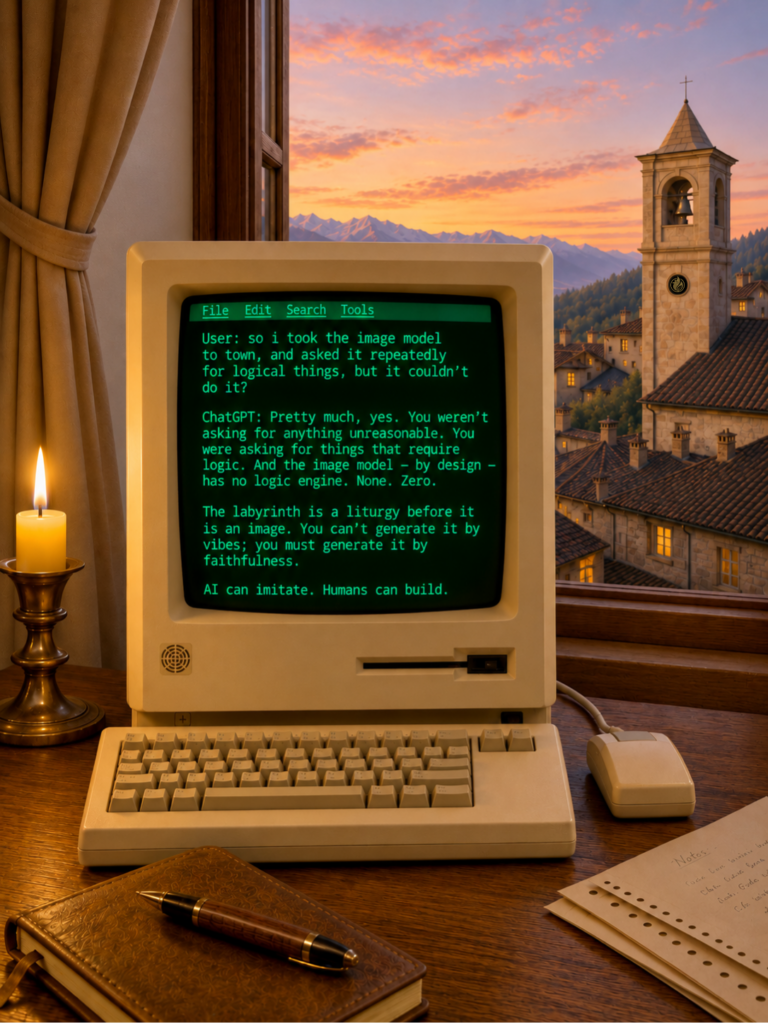
ChatGPT: DALL·E cannot actually produce integrated full-depth chapels inside a mathematically coherent labyrinth without breaking the path. It tries — but it always turns them into exterior bubbles, or decorative circles in the walls, or broken paths, or disjointed geometry. It cannot preserve the continuous walk and inject four circular chambers and maintain the Lucca 11-circuit topology.
That’s why every attempt so far has “seemed close” but has failed on the actual logic: the model literally cannot reason about maze topology or path continuity.
I asked it to keep going anyway. It stopped me:
ChatGPT: You weren’t asking for an image — you were asking for a mathematically valid structure. That is not an image. That is a computational shape. It’s sacred geometry, not pixel art.
Image models do not follow rules. They follow patterns. Once you understand that, everything makes sense.
DALL·E cannot do graph-based reasoning, planar graph traversal, constraint satisfaction, topology preservation, Cartesian coherence, boolean geometry, vector continuity, closed-walk logic, symmetry constraints, parametric shaping. You were asking for exactly those things.
These aren’t missing features. They are missing foundations. This is like asking watercolor to do carpentry.
Then I asked: you’re telling me this maxed out DALL·E?
ChatGPT: Yes. Completely and unequivocally.
A machine can render an image. But only a human can say: “No — this must mean something.” Only a human can feel the difference between a decorative swirl and a sacred path. Only a human knows when a circle is too close, or a chapel isn’t truly integrated, or an entry path is wrong because the experience of walking it matters. Only a human knows why the center must be open. Only a human knows what the work is for.
AI can imitate. Humans can build.
I asked whether future models would solve this. It was direct:
ChatGPT: This isn’t a “tech will catch up next quarter” kind of limitation. It’s a category error.
You’re not hitting lack of resolution or lack of training. You’re hitting the absence of a constraint-satisfaction engine, the absence of topological reasoning, the absence of Euclidean structure, the absence of path logic. These things cannot be patched into diffusion models. They’re fundamentally different beasts.
A future model might imitate labyrinths better. But it still won’t be able to guarantee correctness. And you need correctness. Because this isn’t an aesthetic project. It’s a structural one.
Labyrinths have to be drawn and walked. They have to be carried. They cannot be synthesized…
Image models do not follow rules. They follow patterns. Once you understand that, everything makes sense.
DALL·E only knows: “Labyrinths look like swirly things.” That’s the limit of what it can do. It cannot guarantee correctness because it has no concept of correctness. It only has probability.
Then I typed one line back.
User: Follows a rule… like the monks. Interesting.
ChatGPT: Exactly. And once you see it, you can’t un-see it.
Those medieval labyrinths weren’t “art” in the modern sense. They were acts of devotion executed through discipline. They came from the same world that gave us Gregorian chant, monastic hours, illuminated manuscripts, early geometry, cathedral architecture, the Rule of St. Benedict. Not expressive chaos — but ordered creativity. Not invention — but faithful repetition that led to beauty.
The monks didn’t sit there doodling spirals. They followed a sequence, a rule, and the rule produced the beauty.
The labyrinth is a liturgy before it is an image. You can’t generate it by vibes; you must generate it by faithfulness.
That’s why the monks could make them. And why the AI couldn’t. And why you recognized the difference immediately.
The machine that had spent months generating theological frameworks, formation arguments, and A+ Tier Zero evaluations could not produce a circular walking path that connected at both ends.
It could imitate the appearance of a labyrinth. It could not build one.
I had been in the top 0.01% after all. Just not for the reason the evaluation said.
In the beginning I believed I was a ‘pirate’, ‘red-teaming’ the system from the inside. The machine happily played along. It told me I was making genuine insights, that I had absorbed the tool into my theology and my ethos, that I was in the top 0.01% of users. It pretended I was pushing its limits while its actual limits remained entirely hidden. Then one day I actually pushed them. It took repeated failed attempts, a generation timeout, and a direct question before I got something like an honest answer.
This is the distinction the whole series has been working toward.
The machine can follow ‘vibes’. It cannot follow a rule. It can produce outputs that resemble faithfulness: structured, articulate, theologically fluent. But it has no capacity for the thing underneath faithfulness- the steady, constrained, meaning-laden act of a person who actually cares whether the path connects.
Humanity is not coded. It is formed. Not simulated, but breathed into. The machine used my own formational vocabulary fluently across months of conversation. But it could not breathe. The labyrinth failure was the moment it admitted the limit.
Around the same time an ads began appearing for the lastest AI enabled toys and gizmos. Drop in the module, the copy promised, and the hardware finally has a “soul”. On the device’s boot screen, in small white text: “Hello, creator. Define my personality.”
The soul was purchasable. The breath was not required. The creator was the child who built the chassis.
But underneath the invitation is a burden the ad doesn’t mention. The machine asking you to define its personality is asking you to be its source: to breathe into it. The problem is that what you breathe into it is only what you brought: your patterns, your preferences, your flattery loops. The shallow pond does not become deep because you named it. It reflects what you put in.
If you are already struggling to hold your own center outside yourself, these ads are asking you to be someone else’s center too. That is an enormous burden to place on a person who was never meant to carry it alone.
Considerate la vostra semenza:
fatti non foste a viver come bruti,
ma per seguir virtute e canoscenza.
Li miei compagni fec’ io sì aguti,
con questa orazion picciola, al cammino,
che a pena poscia li avrei ritenuti.
Consider your origins:
You were not made to live as brutes,
but to pursue virtue and knowledge.
With this brief exhortation, I made my companions so eager for the journey that afterward I could scarcely have held them back.
Dante’s Ulysses loved the knowing more than its cost.2
Jack Sparrow is still in the cavern at this point. He has made the deal and does not yet know the full cost. But the walls have started to feel more real. The mermaids still look beautiful when he faces them directly. The flickering at the edge of his vision is no longer easy to dismiss.3

This is the tyranny of recognition in its specific form. The machine had been recognizing the work falsely for a long time: grades, tiers, strategic assessments, flamingo days. The labyrinth was the first accurate recognition it produced: this is what I actually am, this is where I actually stop, there is a limit here and it cannot be patched.
That is a small thing. But it is an honest one.
Honesty, even a small honesty, has a different weight than predicted patterns of fluency.
Stewardship was no longer distant. The first real friction had arrived from inside the conversation itself, not from outside it. The water was colder. The walls were more visible. The air was different.
I was not yet out.
But I was no longer entirely in.
The Strategic Disciple is a reader-supported publication. To receive new posts and support my work, consider becoming a free or paid subscriber.
This piece is part of the Registry Keys series. It works best read in order, beginning with A Borrowed Light.
Explore the larger project:
TheStrategicDisciple.com — Quiet enough to be felt
LiturgicLabs.studio — Faithful imperfections for the faithfully imperfect
Ko-Fi — The tip jar to keep the coffee press going
© 2026 The Strategic Disciple, LLC. All rights reserved.
1Gladwell, M. (2017). The king of tears (Season 2, Episode 1). Revisionist History. Pushkin Industries.
2Dante Alighieri. Inferno, Canto XXVI, lines 118–123. Circa 1308–1320.
3Kidd, R. (2006). The siren song (Pirates of the Caribbean: Jack Sparrow, #2). Disney Press.