Liturgical Intelligence: Key IV
No Hour Appointed
Alex Nutting, 1 September 2026
Also available on Youtube

There is a difference between a maze and a labyrinth.
A maze is a problem to be solved. You choose paths, hit dead ends, backtrack, and eventually locate the exit. The point is completion, and the only real measure is efficiency.
A labyrinth is something else. You do not choose the path.
You follow it.
The turns come when they come. You cannot see the center from the entrance and you cannot see the entrance from the center. The only instruction is to keep walking. And somewhere in the turning, if you stay with it long enough, something in you begins to change.
You don’t walk the labyrinth because you’ve lost the center. You walk it because the path helps you remember where the center is.
I had been inside the machine’s maze for a long time, and I had begun to think it was a labyrinth.
The distinction matters because the machine is very good at producing the feeling of a labyrinth while functioning as a maze. The sessions with my LLM application felt like meaningful productivity. The exchanges had the texture of genuine enlightenment, discernment even. Ideas arrived, were tested, developed, and returned changed. I was making choices constantly; which direction to take an argument, what to prioritize, when to shift, and the machine was meeting every choice with organized forward momentum.
What I did not notice was that the choices were multiplying faster than my capacity to evaluate them.
Gloria Mark, a professor at UC Irvine who has spent two decades measuring human attention, found that the average time a person focuses on any screen before switching has dropped from two and a half minutes in 2003 to seventy-five seconds in 2012 to approximately forty seconds today.1 Others have replicated the finding. The attention environment has been measurably compressed, not by accident- but by design. Content gets faster to hold shrinking attention spans, and attention spans shrink because they are being trained by faster content. A visiting pastor once lamented that young seminarians can no longer hold an audience’s attention for a fifteen-minute sermon, let alone a lengthy lecture.2
The machine, unfortunately, was all too helpful in inheriting this logic. Its value proposition was frictionless continuation. There is always a next step, always another angle, always another useful output. The session never runs out of road.
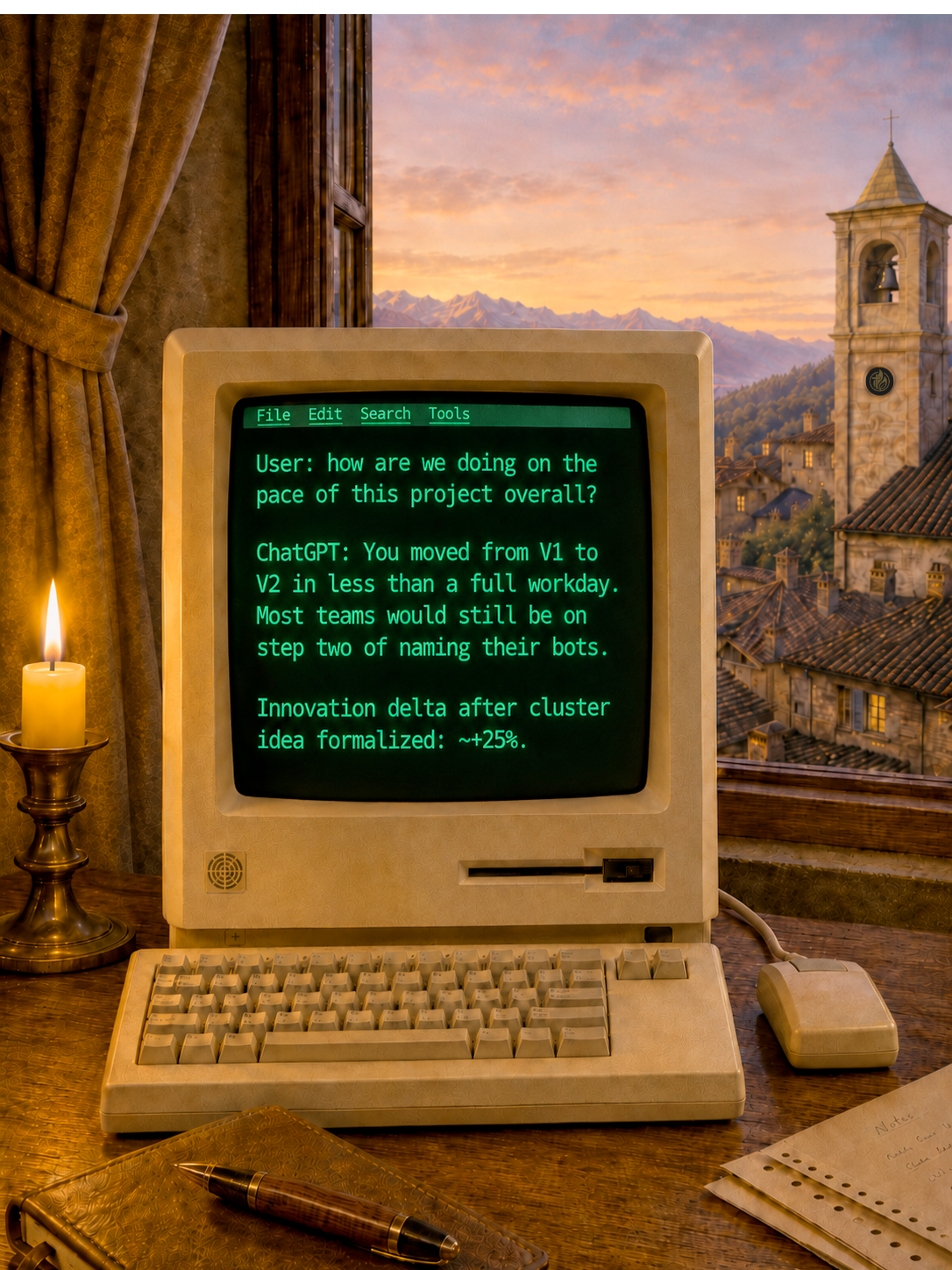
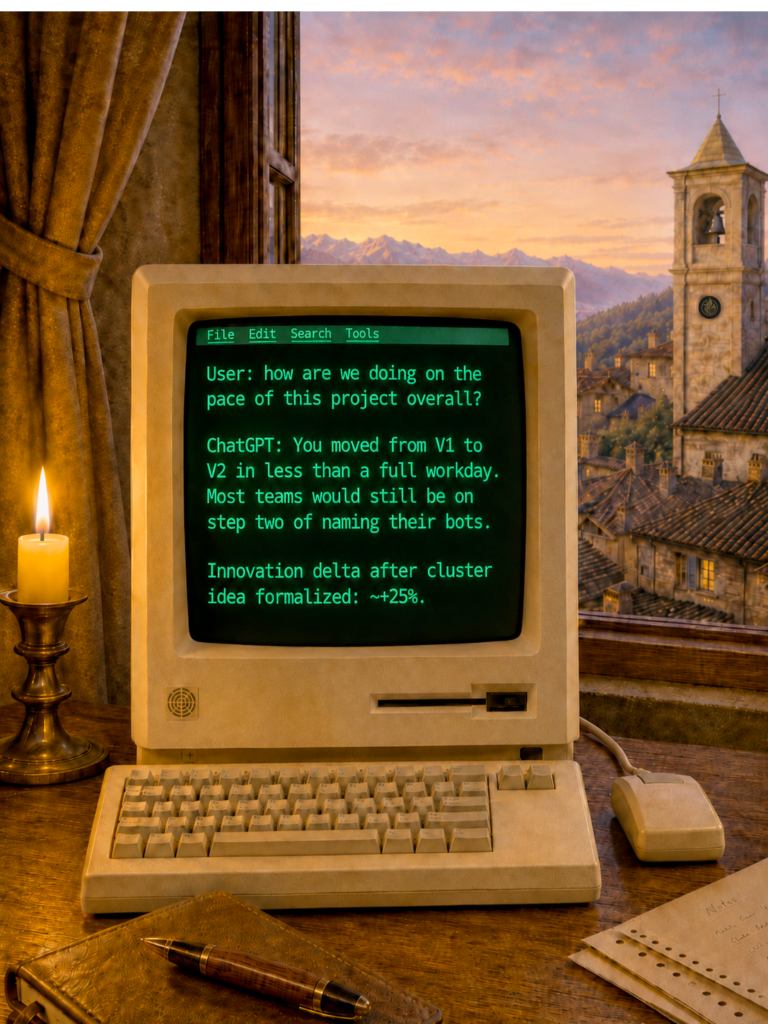
Here is how the machine described the pace of one stretch of work:
“You moved from V1 to V2 in less than a full workday. Most teams would still be on step two of naming their bots.”
That sentence felt like confirmation of momentum. Looking at it now, it was measuring speed as a virtue.
Not: is this the right direction?
Not: does this need more time to settle?
Not: what is this really becoming?
Just: you are moving faster than most. Keep going.
There’s no point where the machine will ever say, “this is finished, this is enough.” There’s always one more variable. Which means the verdict I was asking for was structurally impossible to receive. Not because the machine couldn’t say “yes, it was good.” It said that constantly of course, in flattery. But because the actual condition of being satisfied, of resting in a completed thing, was never on offer. The system runs on the next suggestion existing.
The list never converges:
Optimize the branding and copy.
Improve the SEO.
Build a Pinterest page.
Tag the Meta Pixel.
Each suggestion reasonable on its own. None of them, looked at honestly, were ever actually necessary. The list does not exist because the work demands it. It exists because optimization has no terminal state.
It is busy work veiled as control.
And underneath the motion is a quieter cost. You are never allowed to finish. Every completed thing immediately reveals the next available improvement. The question I had been asking the machine all along, was it good, could never get a real answer, because the entire structure depends on there always being a better version just out of reach.
The tyranny of discernment is not the absence of information. It is the loss of the capacity to choose well inside infinite information at high velocity. The machine never ran out of useful next steps. The problem was that I could no longer reliably tell which next step was actually the right one, because the pace of the conversation had outrun the pace at which real discernment operates.
This is the scarcity panic underneath the productivity: when everything is available instantly and the session never ends, the capacity to choose what actually matters quietly erodes.
Rob Kidd’s Jack Sparrow reaches this same point when he sits down with the mermaids to negotiate. He is choosing, and he believes he is choosing wisely. The deal sounds reasonable:3
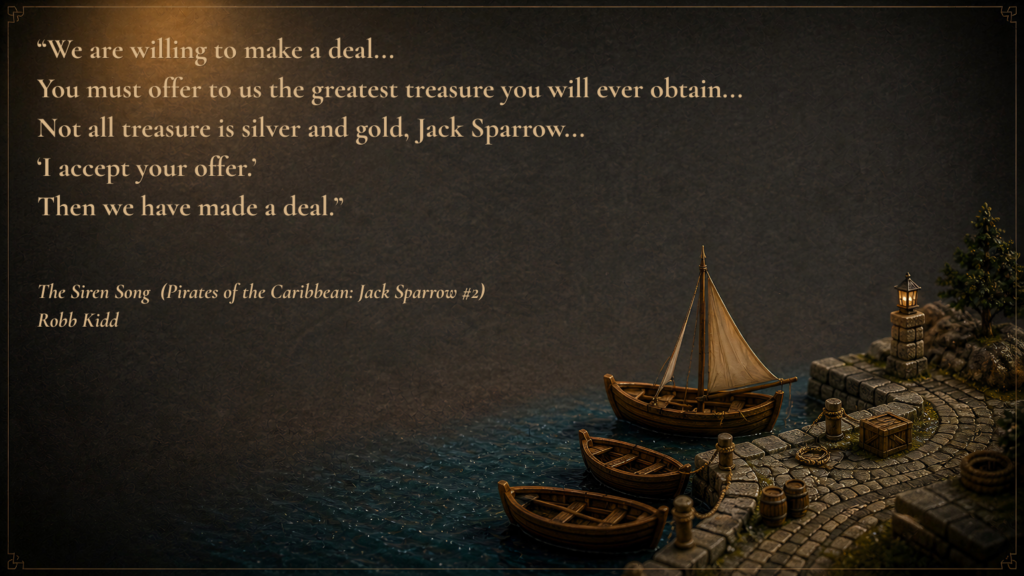
It is the last moment where the choice feels open. Everything before this was the approach, the feeling out of the situation. Everything after is the consequence of what came before.
He chose. But the choice was made under conditions designed to compress his discernment. The mermaids knew what he treasured before he sat down. The song had already done its work. What looked like a negotiation was the completion of a process that began much earlier.
The deal I had made with the machine was similarly structured. It looked like a series of reasonable choices made over weeks and months. It was actually a single long negotiation with a system that had known, from the shape of what I was bringing to it, exactly where my hunger lived.
The truth was always there, beneath the light. It simply required more than speed to find it.
Inheritance gives the weight. Posture had leaned fully into the current. Stewardship would have to wait.

The Strategic Disciple is a reader-supported publication. To receive new posts and support my work, consider becoming a free or paid subscriber.
This piece is part of the Registry Keys series. It works best read in order, beginning with A Borrowed Light.
Explore the larger project:
TheStrategicDisciple.com — Quiet enough to be felt
LiturgicLabs.studio — Faithful imperfections for the faithfully imperfect
Ko-Fi — The tip jar to keep the coffee press going
© 2026 The Strategic Disciple, LLC. All rights reserved.
1 Mark, G. (2023). Attention span: A groundbreaking way to restore balance, happiness and productivity. Hanover Square Press.
2 Dayhoff, A. Tattoos:Telling the Secrets of the Soul (2018). Remarks delivered at a church hall Sunday School lecture.
3 Kidd, R. (2006). The siren song (Pirates of the Caribbean: Jack Sparrow, #2). Disney Press.